Artificial Intelligence (AI) is reshaping the software engineering landscape, creating new opportunities to accelerate development, improve software quality, and strengthen cybersecurity. Within the AI4SWEng project, Work Package 4 (WP4) plays a central role in the transformation of research results and prototype technologies into practical solutions which can support software teams in real operational environments. WP4 focuses on the implementation of the AI-powered Software Development and Testing Automation Framework (Fig. 1). Its mission is to deploy and integrate the innovative tools developed in earlier work packages into a cohesive ecosystem that fits naturally within modern software engineering practices, acting as the bridge between conceptual innovation and industrial application.
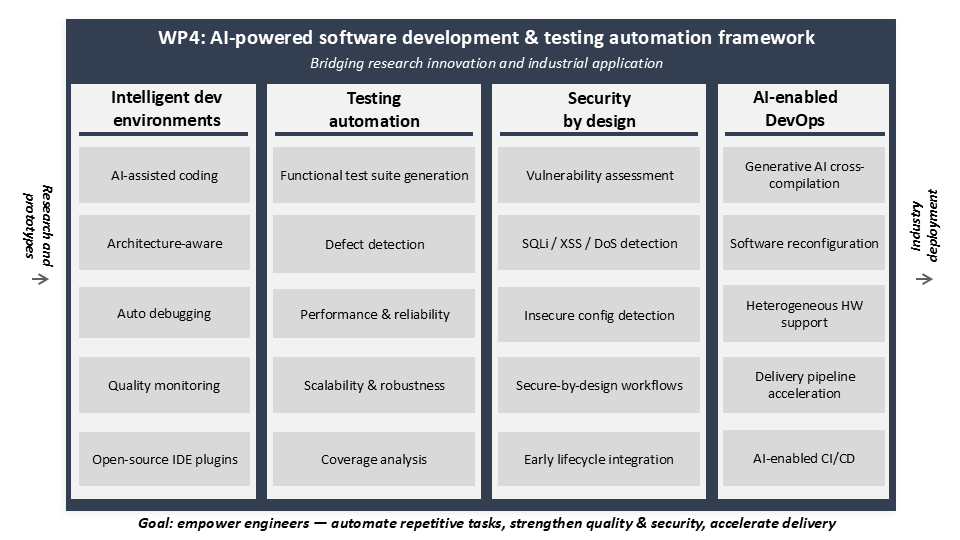
Today’s software organisations face growing pressure to deliver reliable products faster, while also meeting increasingly demanding expectations regarding security, scalability, and maintainability. WP4 addresses this challenge by combining advanced AI capabilities into a unified framework that supports the full software development lifecycle. Rather than introducing isolated tools, the work package aims to create a connected environment where intelligent services assist developers from design to deployment. A key objective of WP4 is the creation of intelligent development environments that enhance productivity and reduce repetitive effort. This includes the integration of AI-assisted coding support, architecture-aware development processes, automated debugging, and continuous quality monitoring. These tools are designed to work alongside developers, helping them make faster and better-informed decisions while preserving human oversight and creativity. WP4 is also contributing demonstrator plugins for open-source development environments, bringing AI support directly into the tools that developers use every day.
Another important pillar of WP4 is testing automation. Software testing remains one of the most resource-intensive phases of development, particularly when systems become more complex and release cycles become shorter. WP4 introduces intelligent testing solutions capable of generating functional test suites adapted to specific codebases and software architectures. These technologies aim to improve test coverage, accelerate defect detection, reduce manual effort, and increase confidence before software release. In parallel, functional and non-functional testing methods are combined to assess reliability, performance, usability, scalability, and robustness.
Security is also deeply embedded in the objectives of WP4. As cyber threats continue to evolve, secure software engineering must become an integral part of development rather than an afterthought. For this reason, WP4 includes AI-supported vulnerability assessment and mitigation capabilities that help identify weaknesses early in the lifecycle. The framework is designed to support the detection of common risks such as SQL Injection, Cross-Site Scripting, Denial of Service attacks, insecure configurations, and unsafe coding practices. By integrating these capabilities into development workflows, WP4 promotes a strong security-by-design culture. An additional innovation area within WP4 concerns the use of generative AI for cross-compilation and software reconfiguration through AI-enabled DevOps components. These capabilities can help organisations to adapt software across heterogeneous hardware and deployment environments more efficiently, while simplifying complex engineering processes and accelerating delivery pipelines.
Overall, WP4 is not about replacing software developers. It is about empowering them. By automating repetitive tasks, supporting decision-making, strengthening testing, and improving security assurance, the framework allows engineering teams to focus on higher-value activities such as creativity, architecture, and innovation. Through these efforts, WP4 contributes directly to the broader vision of AI4SWEng: building trustworthy, efficient, and human-centric AI solutions that strengthen Europe’s software engineering capabilities. As implementation progresses, WP4 will continue turning advanced research into practical tools that make software development smarter, faster, and safer.